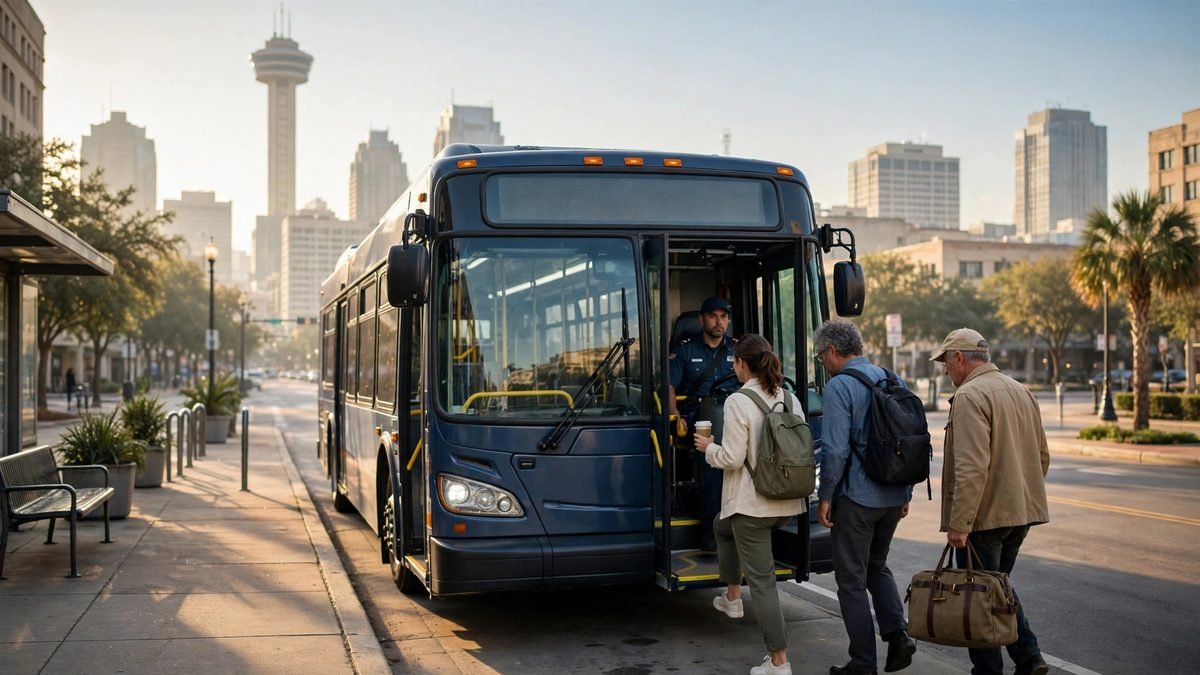
VIA Metropolitan Transit: the city's bus system
VIA is a serious employer: 2,256 employees, 452 buses, and 137 vans across a 1,210-square-mile service area, by VIA's own published figures. Its careers page currently features Bus Operator hiring with paid training, a uniform allowance, and a hiring incentive of up to $4,000 for eligible applicants. VIA states its core requirements plainly: at least 3 years of driving experience and 2 years of customer service experience. Its operator posting adds at least 21 years old, a clean driving record, and the ability to obtain a Commercial Driver's License (Class B).
No prior bus experience is necessary — VIA's hiring releases describe paid training with classes starting weekly. The benefits list is the public-employer package: family medical coverage, dental and vision, life insurance, paid vacation, sick leave and holidays, longevity pay, shift differentials, and tuition assistance. Applications run through VIA's employment page, and VIA posts an application-questions line at 210-362-2240.
One honesty note on pay: VIA's current careers page shows no starting wage. Its January 2025 hiring release listed starting pay of $22.45 an hour for full-time bus operators — a real VIA figure, but a dated one. Ask for today's number in the interview and do not budget on the 2025 release. VIA also hires paratransit van operators for its VIAtrans curb-to-curb service, and its releases say the hiring incentive covers van operators too — the careers page is where those openings appear.
School bus driving: the license stack
Texas school bus drivers carry a specific stack of credentials. The license is a Class B CDL with Passenger (P) and School Bus (S) endorsements. Federal Entry-Level Driver Training applies to first-time Class B applicants and first-time S and P endorsement applicants — your training provider must report completion to the FMCSA registry before DPS lets you take the skills test. On top of the CDL, Texas requires the School Bus Driver Safety Certification Course: 20 hours for new drivers, then an 8-hour recertification every three years, overseen by Texas DPS and delivered through the regional education service centers — Region 20 is San Antonio's. State rules also require an annual DOT physical and an acceptable driving and criminal record, with 18 as the state's age floor — though districts can and do set it higher.
NEISD: paid training, posted pay
North East ISD, one of the largest districts in San Antonio, shows what a district offer looks like on its own transportation jobs page. The posted minimum starting wage is $17.64 to $20.40 an hour depending on previous bus driving experience. The headline is the training: NEISD advertises paid CDL training — you earn money while you learn to drive a school bus — with its trainers preparing you over multiple days behind the wheel; NEISD is itself a CDL third-party skills-testing provider and administers the driving test at its own facility. The district pays for your fingerprint background check, drug test, and DOT physical.
NEISD's minimums: 21 years of age, holding or being able to obtain the Class B CDL with P and S endorsements, no DWI convictions in the past 10 years, and an acceptable driving record. The package includes full-time benefits (health, dental, vision, life), the TRS teacher-retirement pension, five paid holidays, a year-round flexible schedule, optional summer work, and an attendance incentive. The shape of the job is the appeal for many drivers: a morning route, a midday break, an afternoon route — and the same holidays your kids get.
Which bus seat fits you
VIA is the full-time career: year-round transit work, shift differentials, overtime, and a fleet that runs early mornings to late nights — new operators start where the seniority list puts them, which usually means the less-loved shifts first. School districts trade hours for rhythm: split shifts built around the school day, summers light or off, and a pension. Both beat gig work on one measure that matters over a decade — the paycheck does not depend on demand, weather, or an algorithm. If you need the CDL first, our Class A vs Class B guide and the local schools page lay out the training routes, including the free and grant-funded ones.
Compare San Antonio's CDL schools — including district and employer training routes that pay you while you learn.
See CDL schools