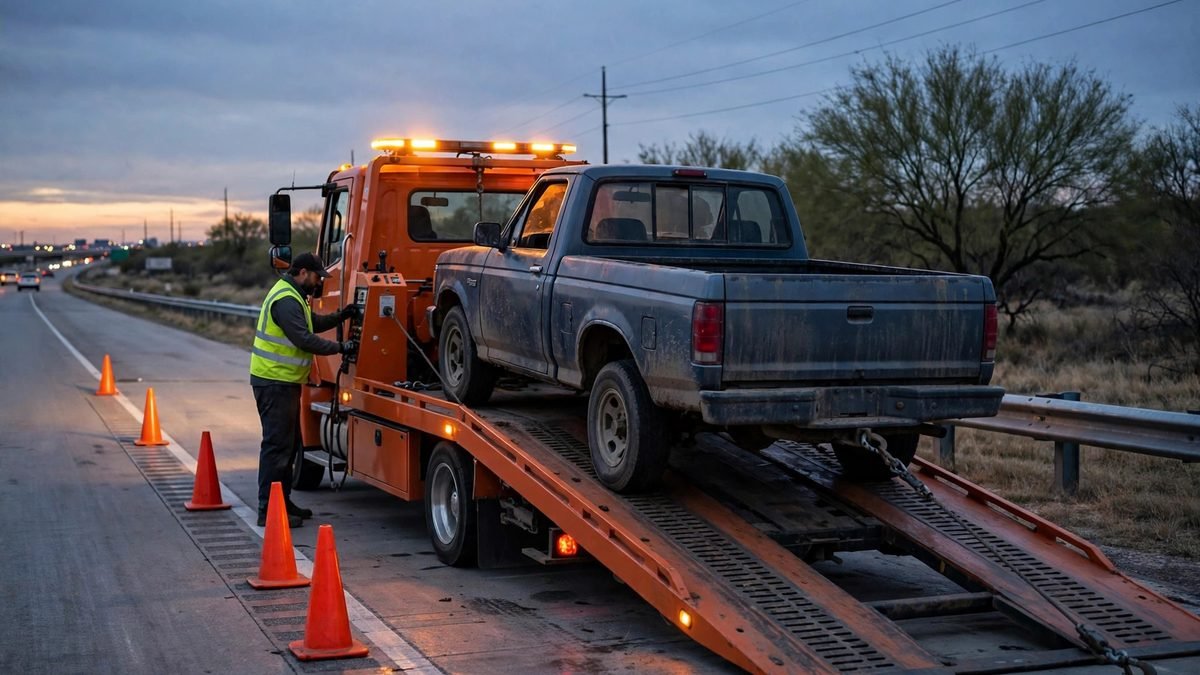
Three licenses, and they stack
The Texas Department of Licensing and Regulation (TDLR) issues three tow operator licenses, under Texas Occupations Code sections 2308.153 to 2308.155. Every tow truck operator in Texas must hold one of them:
The licenses stack downward. An Incident Management operator can run any truck — IM, Private Property, or Consent. A Private Property operator can also run Consent trucks, but not IM trucks. A Consent operator can run Consent trucks only. If you are choosing one license to start a career on, Incident Management is the one that covers everything.
- Incident Management License — police-ordered and accident-scene towing
- Private Property License — towing from parking lots and facilities without the owner's consent
- Consent Tow License — tows the vehicle's owner calls for
What the three kinds of towing actually are
Incident Management towing is non-consent towing started by a peace officer, plus any tow from a traffic incident or accident — TDLR's rule is broad: any tow of a vehicle from a public roadway, for any reason, is an incident management tow. This is the wreck-at-midnight, clear-the-highway work.
Private Property towing is also non-consent, but it is authorized by a parking facility owner — TDLR's own examples are apartment complex lots, restaurant lots, and paid parking lots. Consent towing is the familiar one: the owner or someone with custody of the vehicle calls and asks for the tow. A driver whose company does apartment patrols needs the PP license; a driver running roadside-assistance calls needs at least Consent; accident and police work needs IM.
Getting licensed: the steps
TDLR's operator application asks for a valid driver's license issued by a US state and a $100 non-refundable application fee; the license runs one year. The step applicants miss: Incident Management and Private Property applicants must be certified BEFORE licensure by an approved training program — the list includes the Towing and Recovery Association of America's National Drivers Certification Program, WreckMaster, AAA Texas, the Texas Towing and Storage Association, the Southwest Tow Operators Association, and others. Consent Tow applicants do not need certification. TDLR itself runs no classes — the certification comes from those programs.
Every applicant also goes through a TDLR criminal history background check. Anyone ever convicted of a felony or a misdemeanor (beyond a minor traffic violation), or who took deferred adjudication on a plea, must file a Criminal History Questionnaire with the application. TDLR reviews case by case — the nature of the conviction and how long ago it happened both count, and review can take one to six weeks. If you are unsure where you stand, TDLR offers a pre-application Criminal History Evaluation Letter so you can find out before you pay for certification.
The company and the truck are licensed too
Your license is only one of three layers. The tow company must hold its own TDLR company license ($350 a year, with every owner, officer, and manager passing a background check), and every truck needs its own TDLR permit ($75 per truck) in one of the three categories, with plates that read Tow Truck and the company's name, phone, city, and permit number lettered at least two inches high on the truck.
Insurance minimums ride on the truck's permit: Incident Management trucks carry at least $500,000 liability and $50,000 cargo (on-hook) coverage per incident; Private Property $300,000 and $50,000; Consent $300,000 with no cargo minimum. Companies must also adopt a drug and alcohol testing policy for employees — TDLR's model policy, an approved testing consortium, or their own filed policy at least as strict. Expect to be tested under it.
Do you need a CDL to drive a tow truck?
The TDLR license itself requires no CDL — just a valid driver's license. The CDL question is decided by weight, under Texas DPS license classes. A Class A CDL covers a combination of vehicles rated 26,001 pounds or more where the towed vehicle is over 10,000 pounds; a Class B covers a single vehicle rated 26,001 pounds or more. In plain terms: light and medium wreckers run on a regular license, and the heavy-duty rotator work — big wreckers recovering loaded semis — is where the CDL becomes part of the job. Companies will say which class a given truck needs in the posting or the interview.
How police towing works in San Antonio
SAPD impounds vehicles at the city-owned Growdon Road Vehicle Storage Facility. Police-directed towing in San Antonio runs through a city-contracted manager — the City Council approved a contract with United Road Towing Inc., doing business as United Road Vehicle Management Solutions, to manage police-directed tows, vehicle storage with evidence processing, and auctions for SAPD, on an initial ten-year term. Licensed local companies do the actual towing inside that structure, bringing in the vehicles of arrested drivers, accident vehicles, and vehicles seized as evidence.
The other half of the job sits at the storage lot itself. Anyone working at a vehicle storage facility must hold either a VSF employee license ($75 through TDLR) or one of the three tow operator licenses — your operator license already qualifies you, which is why tow drivers often rotate between the truck and the lot. Storage-facility staff work under explicit drug-testing rules: a test after a conditional offer, at least one scheduled test every 12 months, and random testing in between.
Our towing directory lists the local companies running trucks across San Antonio — the same names that hire licensed operators.
See towing companies