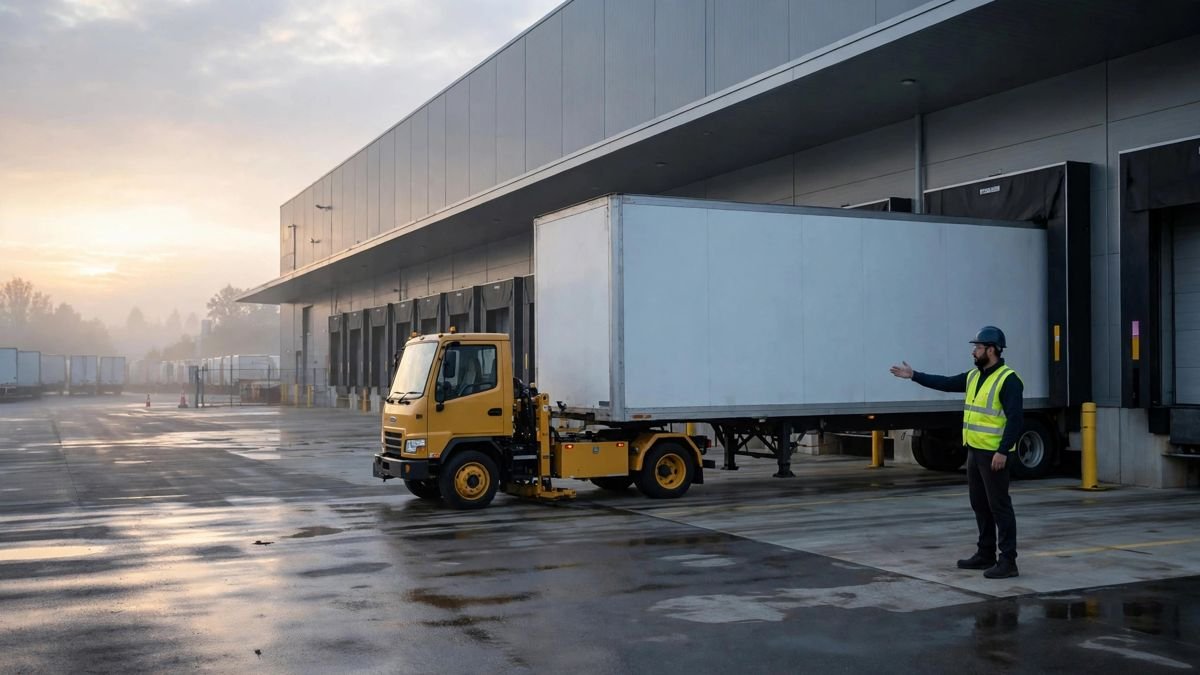
What a yard driver actually does
The job goes by several names — yard driver, spotter, yard jockey, and hostler, which is the term federal guidance uses for employees who move and park vehicles on a facility's property. The work: hook a terminal tractor (a yard dog) to a trailer, move it from a yard slot to a dock door, spot the empties, stage the loaded ones, open and close doors, set landing gear, and keep the dock schedule moving. A busy distribution yard moves trailers around the clock, so shifts cover nights and weekends too.
It is backing, precision, and rhythm rather than miles. Drivers who are good at it are worth a lot to a warehouse: every late trailer is a dock crew standing still.
Do you need a CDL? The actual rule
Federal Motor Carrier Safety Administration guidance draws a bright line. Hostlers who maintain and park vehicles on facility property are not subject to CDL requirements — as long as they do not operate on public highways. The CDL attaches to driving a commercial motor vehicle on roads open to the public. A yard-only driver moving trailers on a closed private lot sits outside the federal CDL rule.
Cross that line and the rule flips: the moment the truck operates on a public road — or even a private road that is open to public travel — CDL requirements apply in full.
Here is the part applicants miss: the law sets the floor, but employers set their own policy on top of it. Nothing stops a warehouse from requiring a CDL, a medical card, or prior tractor-trailer experience for a yard job anyway, and many do — it keeps their options open for road moves. Read each posting for what that employer asks. No CDL required by law does not mean no CDL asked by the company.
Where the big yards are in San Antonio
H-E-B is the giant. Its San Antonio distribution operation includes the Perishable Distribution Center at 4710 N. PanAm Expressway, and H-E-B's own job postings describe a network of 11.9 to 12.1 million square feet of warehousing kept moving by Distribution Center and Transportation Partners — which means trailer yards, dock schedules, and yard work at serious scale.
Amazon is the other anchor: two fulfillment centers in San Antonio plus a 350,000 square foot delivery station at 8210 Aviation Landing, announced together as more than 1,500 full-time jobs. Add the warehouse corridors along I-10 on the east side and I-35 north — food, beverage, building materials, and freight all stage trailers in this city — and yard driving is one of the steadiest driving specialties in San Antonio.
Skills that get you hired
Yard supervisors hire for trailer control first: smooth backing into tight dock doors, clean hookups, fifth-wheel and landing-gear checks done the same way every time, and yard safety around dock crews and forklifts. Experience in a tractor-trailer — even without a CDL history — counts, as does a clean safety record anywhere you have driven for work.
Treat the job as a platform, too. A year of daily trailer handling is the best possible preparation for a CDL skills test: yard drivers who go get their Class A already back better than most students. Several San Antonio drivers make exactly that jump, from the yard to the road, with the same employer.
A Class A CDL turns trailer handling into the highest-paid driving work in San Antonio. Compare the local schools — including the free and grant-funded routes.
See CDL schools