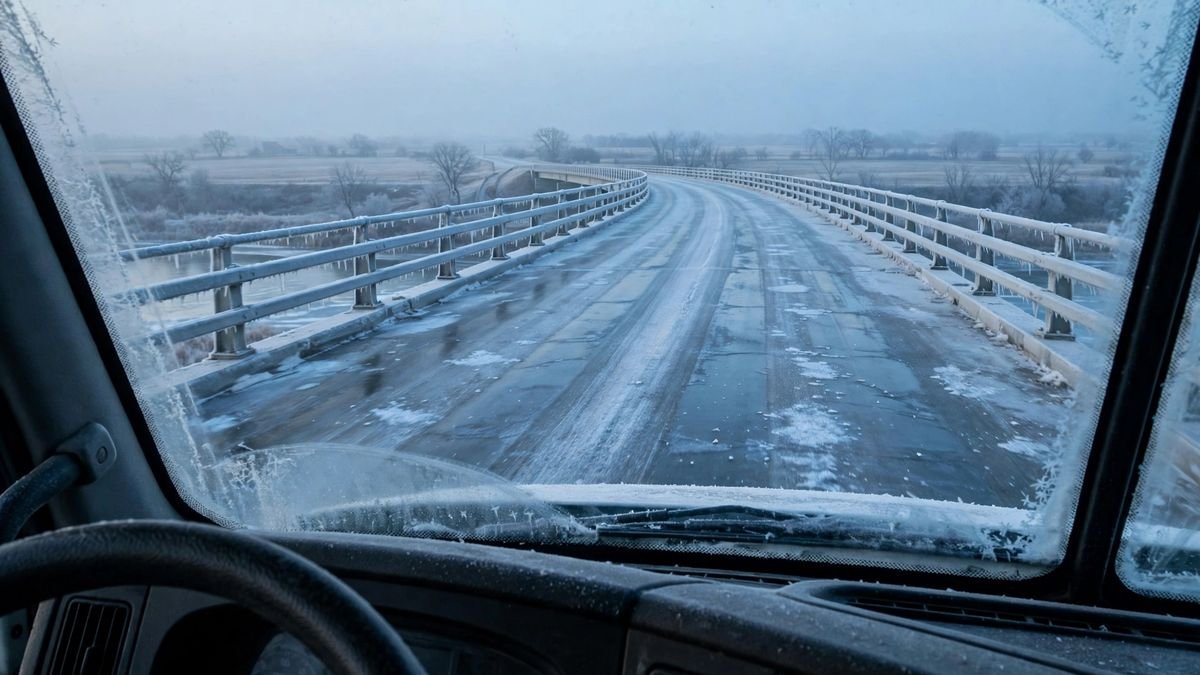
The law first: what 49 CFR 392.14 actually requires of you
Federal regulation 49 CFR § 392.14 is the rule that governs your ice day, and it is stricter than most drivers realize: “Extreme caution in the operation of a commercial motor vehicle shall be exercised when hazardous conditions, such as those caused by snow, ice, sleet, fog, mist, rain, dust, or smoke, adversely affect visibility or traction. Speed shall be reduced when such conditions exist. If conditions become sufficiently dangerous, the operation of the commercial motor vehicle shall be discontinued and shall not be resumed until the commercial motor vehicle can be safely operated.”
Read that last part again: parking it is not quitting — it is the regulation. No load, dispatcher or delivery window outranks it, and if the worst happens, this paragraph is what investigators read first. The professional move on a Texas ice morning is a documented decision: check conditions, reduce speed hard, or stop — and tell dispatch early, in writing.
FMCSA's speed math: a third off wet, half off snow-packed
FMCSA's published driving tips put numbers on “slow down”: reduce speed by one-third on wet roads and by half or more on snow-packed roads — their worked example runs 60 mph dry to 40 mph wet to 30 mph on snow. On ice, treat even that as a ceiling, not a target.
The same FMCSA guidance explains why: a loaded tractor-trailer at 55 mph in ideal conditions needs about 196 feet to stop, against 133 feet for a car, and FMCSA's crash research found 23% of large-truck crashes involved a driver traveling too fast for conditions. On an icy bridge deck, your stopping distance stretches far past that 196 feet while the cars around you — driven by people with even less ice experience — slide into spaces you were counting on.
Black ice: the Texas specialty
The National Weather Service defines black ice as patchy ice on road surfaces that cannot be easily seen — clear ice with the black pavement showing through — most common in the early morning hours, when meltwater has refrozen overnight as temperatures dropped below freezing. FMCSA's recognition cue is worth memorizing: if the pavement ahead looks wet while the surrounding area looks dry, it may be black ice — slow down and avoid the patch.
Central Texas ice usually arrives as freezing rain, and it does not take much: the Weather Service notes that even 0.01 inch of freezing rain once caused a 70-car pileup, and a trace of ice on roadways is enough for a Winter Weather Advisory. The freezing-rain setup — rain melting in a warm layer aloft, then freezing on contact with cold surfaces — is exactly what a wet El Niño winter can deliver here.
Bridges, ramps and overpasses freeze first
TxDOT's winter guidance is blunt about where Texas ice bites first: bridges, ramps, overpasses and shaded areas freeze before the road at ground level, because cold air circulates under an elevated deck and chills it from both sides. San Antonio's stacked interchanges — I-10/I-35 downtown, the I-410 and Loop 1604 flyovers — are chains of exactly those surfaces.
TxDOT's published driver tips add the working rules: maintain at least three times your normal following distance on snow or ice, stay at least 200 feet behind snow plows and treatment trucks, never use cruise control on slick roads, keep headlights on, and if the truck starts to slide, ease off the pedals and steer into the skid. Before any winter run, check conditions at DriveTexas.org or 1-800-452-9292 — TxDOT crews pretreat highways with brine ahead of forecast events and run 24/7 once winter weather hits, so the map shows where they're working.
Your ice-day routine
- Night before: check the NWS Austin/San Antonio forecast and DriveTexas.org; if ice is expected at your start time, call dispatch before the alarm clock, not from the yard.
- Pre-trip: clear every window, mirror and light completely; check tire pressures (they drop 1–2 psi per 10°F of temperature fall); confirm the defroster and wipers actually work.
- Rolling: speeds at FMCSA's reductions or lower, following distance at three times normal, no cruise control, and treat every bridge deck as ice until proven otherwise.
- The stop decision: if you cannot hold your lane comfortably at reduced speed, conditions are 'sufficiently dangerous' under 392.14 — park somewhere safe that is not a shoulder, and notify dispatch.
- Carry the kit TxDOT recommends: blankets, water, a phone charger, and a full tank — Texas ice jams can strand traffic for hours.
New San Antonio driving jobs land all season — join the free CDL job alerts and get them by email. No spam, unsubscribe anytime.
Join the free job alerts