Fuel: know your cloud point before the cold does
Diesel doesn't freeze solid — it gels in stages. Per Cummins' published winter diesel guidance (with Power Service), the cloud point is where wax crystals first solidify and the fuel turns cloudy; typical diesel cloud points run from 32°F down to 10°F depending on the batch, and past the cloud point the crystals clump until they plug the fuel filter and shut the engine down. Biodiesel blends gel much sooner, with cloud points of 30–50°F.
The rule that saves drivers: anti-gel additive only works if it's in the tank before the fuel reaches its cloud point — the Cummins-endorsed treatment (Diesel Fuel Supplement + Cetane Boost) must be added while the fuel is still above that temperature. Adding it after gelling does nothing for the wax already formed; the emergency product (Diesel 911) exists to reliquefy gelled fuel and de-ice frozen filters, after which the tank still needs the preventive treatment. Practical version: if a hard freeze is forecast, treat the tank at fueling the day before, top up with winter-blend diesel when you can, and keep filters fresh — a half-clogged filter gels shut first.
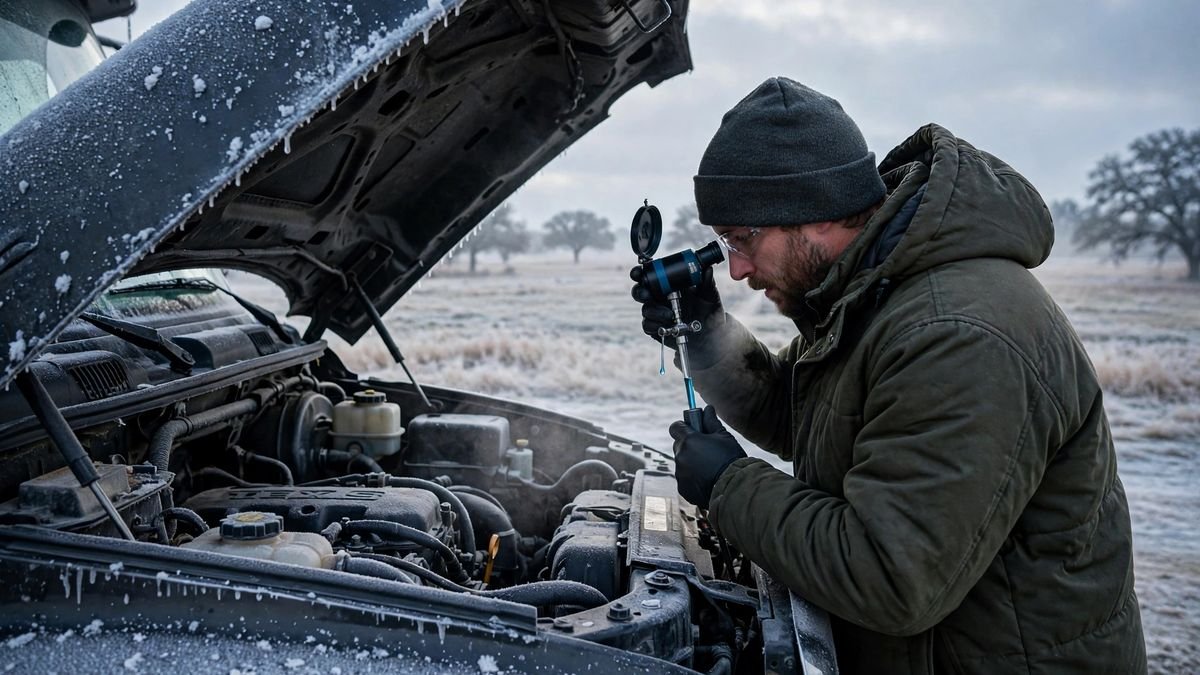
Coolant: test it with a refractometer, not a guess
Cummins' maintenance guidance says coolant freeze protection should be tested at least twice a year — and that a refractometer must be used, because floating-ball testers aren't accurate enough to trust. The standard 50/50 mix of fully formulated antifreeze and quality water protects to about −34°F; going richer isn't better, since protection actually gets worse again past roughly 68% antifreeze.
For a Texas truck, the real risk isn't a −34°F night — it's discovering during the first 25°F night that last summer's top-offs diluted you to water with dye in it. Test in November, record the number, and fix the mix while the fix is cheap.
Batteries and starting: the 0°F math
Cold attacks starting from both sides: AAA's published figures say an engine needs about 30% more energy to start at freezing temperatures, while at 0°F a battery delivers only about half its rated capacity. San Antonio rarely sees 0°F — but a battery that was already weak in October meets its worst morning in January, and a discharged battery can even freeze at 32°F, while a fully charged one won't freeze until far below zero.
Before the season: load-test the batteries, clean and tighten terminals, and check cable condition. During a freeze: if the truck will sit through the coldest nights, a block heater on a timer (where fitted) is the cheapest insurance in trucking — and park out of the north wind when you can.
Tires, air and the small stuff
- Tire pressure falls 1–2 psi for every 10°F the temperature drops (FMCSA) — a 40-degree cold snap can quietly take 8 psi. Check pressures cold, at the door-placard/fleet spec, not the sidewall maximum.
- Drain air tanks: moisture in the air system freezes in lines and valves. Cold snaps are when neglected air dryers announce themselves.
- Wipers and washer fluid: fit winter blades if yours streak, and use washer fluid rated below freezing — summer fluid turns to slush on the windshield.
- Rubber and seals: door seals and reefer gaskets get brittle in the cold; Thermo King's dealer guidance for winter reefer work stresses inspecting door seals and insulation, since small leaks become big temperature swings — and in extreme cold, reefers can overcool and freeze sensitive cargo like produce and dairy, so monitor setpoints, not just alarms.
- Fuel and DEF caps: wipe moisture from around caps before fueling — water in the tank is tomorrow's frozen filter.
The cab kit for a Texas freeze
Texas ice events strand trucks in place more often than they wreck them, and a five-hour standstill at 20°F is a survival problem, not an inconvenience. Keep in the cab from November through February: blankets or a sleeping bag, water that you've rotated, shelf-stable food, a phone power bank, a flashlight, warm gloves and a hat, and any medication you can't skip. If you do get stuck, run the engine periodically for heat — and keep the exhaust pipe clear of snow and ice while you do.
Local fleets hiring San Antonio drivers post all season — get the free CDL job alerts by email and hear about them first.
Get the free job alerts